The 4th Industrial Revolution
We have entered the 2nd wave of the Industry 4.0 that fundamentally alters the way we live, work, trade, invest, and will reset economic models and how we relate to one another.
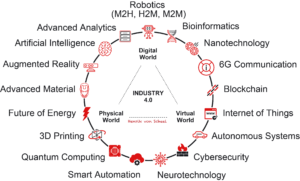
The 4th Industrial Revolution (Industry 4.0) merges the digital, virtual and physical world with 17 colliding trends that each bring about paradigm shift. Each of the trends disrupt every aspect of our lives, economy, every industries and every country with an exponential pace and impact. People are the centrepiece of the Industry 4.0.

The four of industrial revolutions
An Industrial revolution is a period of radically changes that effect society, industries, economies and environments. There are various moments throughout human history, where new technological advancements collide together to new heights, or setting a new bar. Typically due to new technological advancements or discoveries. The industrial revolutions have shaped our world today into a global interconnected society which currently fuels the exponential growth thereof.
The 1st industrial revolution
began in Britain in the late 18th century, with the mechanisation of the textile industry. The invention of mechanical production powered by water and steam started the first of the mechanical automation to create a huge breakthrough in productivity and consistency of production.
The 2nd industrial revolution
began in America in the early 19th century, with the electricity and mass production. It was fueled by the start of mass production powered by electricity and combustion engines to power machine. The first assembly lines were introduced, the use of new materials and chemicals became possible and communication was getting easier.
The 3rd industrial revolution
began in America in the middle of the 20th century with the harness of electronics and information technology to automate production.
In the 1969, the introduction of automation and robotics ushered a new era, the Industry 3.0. Electronics and IT such as internet, mobile, computers, cloud and big data merged into a digital era of the information age.
The 4th industrial revolution
began in Germany in the beginning of the 20th century with the fusion of digital-, physical- and virtual world, also called the cyber-physical systems.
The biggest structural change in the past 250 years is upon us. In its scale, scope, and complexity, the Industry 4.0 fundamentally alters the way we live, work, consume, our economy and how we relate to one another in a scale unlike anything humankind has experienced before.
Origin of the 4th Industrial Revolution
The 4th industrial revolution was triggered by the Germany´s national strategy in 2009 called the “Digital Agenda”. Henrik von Scheel was one of the mastermind behind the Germany’s digital agenda, which evolved into the 4th Industrial Revolution and ignited a global wave of themes on digital Industry 4.0.

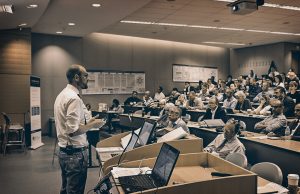
Industry 4.0 Symposium
Become an Industry 4.0 certified expert at the next Industry 4.0 Masterclass. Get insight on the latest of the 4.0 development and how to apply it.

Tailored Industry 4.0 Education
This in-house bootcamp designed for executive teams to examining the Industry 4.0 specific topics with the latest management concepts, techniques and tools.
Explore the strategies, options and define where and how to realize it in operational settings.
Industry 4.0 Prototyping
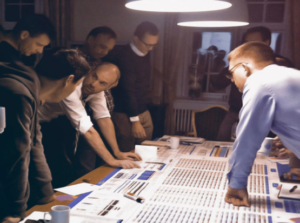
Take a practical approach to Industry 4.0 from exploration, prototyping to execution.
The Industry 4.0 Prototype is designed to fast-track exploration to project execution with your team.
Focusing on where to transform, when to innovate, what to do more or less off and what to stop.

Navigate the impact of the Industry 4.0
In its scale, scope, and complexity, the Industry 4.0 fundamentally alters the way we live, work, consume, our economy and how we relate to one another, unlike anything humankind has experienced before.
It disrupts every aspect of our lives, society, all industries and every country. The main topics include:
Future of Growth
- Disruptive new Business Model
- Service driven Business Model
- Refine Competitiveness
- Smart Products
- Consumer 4.0
- 2nd wave of Industry 4.0
- Artificial Intelligence
- Advanced Material
- Blockchain
- Smart Automation
- Energy Revolution
- 6G Communications
- 3rd wave of Industry 4.0
- Bioinformaticsl
- Cybersecurity
- Neurotechology
- Nanotechnology
- Quantum Computing
Future of Productivity
- Next wave of Operational Excellence
- Smart Automation
- Smart Supply Chain
- Procurement 4.0
- Complexity simplification
- 1st wave of Industry 4.0
- Digitalization (Internet of Things)
- Advanced Analytic (Big Data)
- Cloud Computing
- Robotics
- Digital Currency (Blockchain)
- 3D Printing
- Augmented Reality
Future of Government
- Foreign Direct Investment 4.0
- National Competitiveness
- Globalization 4.0
- Value 4.0
- Future of Work
- Policy Alignment
- Citizien and Taxation 4.0
- Public Finance
- Labour market and Resources
- Smart Cities and Urbanization
- Future of the Economy
- Future of Welfare State
- Smart Infrastructure
- Global Trade and Export 4.0
- Environmental Stewardship
- Natural Resource Security
- Government Delivery Model 4.0
- Future of National Security